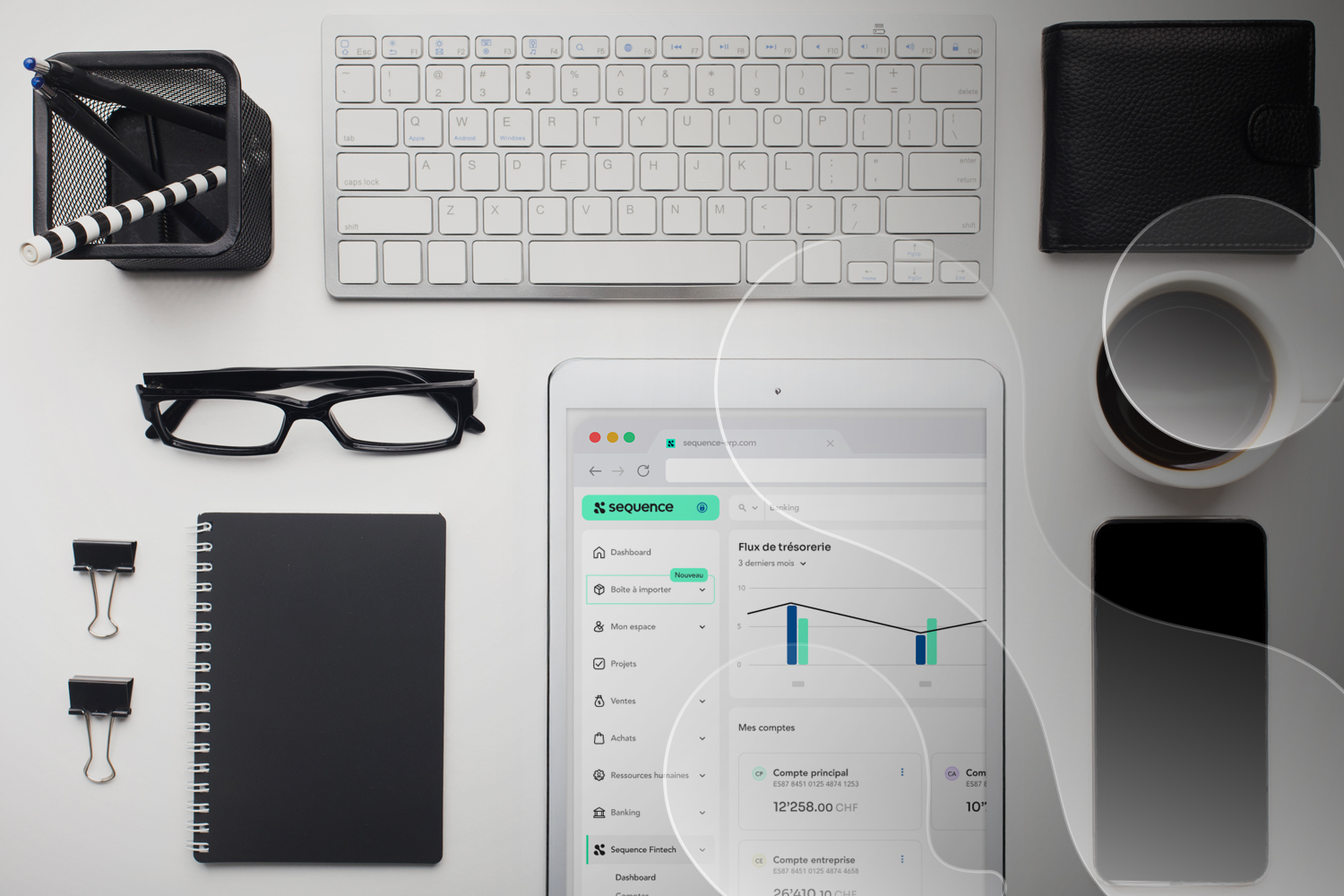
Architects and engineers in French-speaking Switzerland: 3 SMEs that cut their administrative time by a factor of 4
ERP for architects and engineers in Switzerland: 3 SMEs in French-speaking Switzerland cut their administrative time by a factor of 4. Testimonials, figures and practical levers for 2026.

Architects and engineers in French-speaking Switzerland: 3 SMEs that cut their administrative time by a factor of 4

The essentials in 3 points:
- An architectural practice or engineering firm in French-speaking Switzerland spends an average of 25 to 35 % of its total time on administrative tasks: invoicing, project monitoring and accounting reconciliations (source: SIA / USIC survey 2023).
- The three SMEs presented here applied three common levers: invoicing linked to project hours, automated accounting entries and centralised financial flows on a single platform.
- After 12 months, the average results observed are a 75 % reduction in invoicing time and a 50 % reduction in financial monitoring time, bringing the administrative ratio below 8 % of total time.
In architectural and engineering firms across French-speaking Switzerland, the situation is paradoxical: highly qualified professionals spend a significant part of their working week on invoicing, tracking hours and bank reconciliations. Finding an ERP for architects and engineers in Switzerland suited to this reality, meaning one capable of managing long-running projects, successive payments on account and multidisciplinary teams, remains a challenge for many SMEs in the sector. We met three of them. Here is what they changed, what it cost them and what they have gained after twelve months.
Why is the administrative burden so heavy for architects and engineers?
Technical practices are not retail businesses. Their invoicing is inherently complex: it is based on long-term commissions (sometimes 2 to 5 years for a property project), distinct work stages (preliminary design, design, execution, construction supervision), fees calculated according to SIA standard 102/103, and staged payments on account.
In practice, this means:
- Invoices linked to time spent, requiring rigorous tracking of hours by employee, project and stage.
- Frequent revisions: an initial quotation may be amended 5 to 10 times over the course of a commission.
- Multi-project management: a practice of 12 people typically manages 15 to 30 commissions simultaneously.
- Strict accounting requirements: the accounts must reflect work in progress (WIP), provisions and revenue recognised according to progress.
According to a survey conducted by the SIA (Swiss Society of Engineers and Architects) in 2023, self-employed professionals and small firms in the sector spend between 25 and 35 % of their time on administration. For a practice of 10 people billing an average of CHF 150 per hour, this represents an opportunity cost in the region of CHF 300'000 to CHF 400'000 per year.
Case 1: an architectural practice of 12 people in Geneva (GE)
This Geneva practice, specialising in the renovation of historic buildings and new construction, employs 12 staff: 7 architects, 2 draughtspeople, 1 project manager, 1 administrative assistant and 1 founding partner.
The situation before
Invoicing was managed in Excel. Each architect emailed their hours to the administrative assistant, who compiled them manually before issuing invoices. Reconciliation with the accounts (maintained by an external fiduciary firm) took place once a month, with an average gap of 6 weeks between service delivery and payment receipt.
The founder estimated that he spent 2 days per week on financial tasks: approving hours, chasing clients, discussions with the fiduciary firm and cash flow checks.
What changed
The practice migrated to Sequence in March 2025. The three main changes:
- Integrated time recording: each employee records their hours directly in the platform, linked to the relevant project and SIA stage.
- Semi-automated invoicing: invoices for payments on account are generated from approved hours at the contractual hourly rate. The assistant only needs to check and send them.
- Synchronised accounting: entries are generated automatically, and the fiduciary firm accesses the same environment for the quarterly review.
Results after 12 months
| Indicator | Before | After 12 months | Change |
|---|---|---|---|
| Monthly invoicing time | 16 hours | 4 hours | -75 % |
| Average interval from service delivery → payment receipt | 42 days | 23 days | -45 % |
| Founder's time spent on admin | 2 days/week | 0,5 days/week | -75 % |
| Invoicing errors (per quarter) | 5 to 8 | 0 to 1 | -90 % |
[VALIDATE with the client before publication]
Case 2: a civil engineering firm in the canton of Vaud (VD)
This Vaud-based firm employs 8 civil engineers and 3 technicians. It works mainly on civil engineering structures, load-bearing structures and earthquake engineering. Its client base consists of 60 % public-sector commissions (municipalities, canton) and 40 % private-sector commissions.
The situation before
The firm used project management software (without accounting functionality) combined with separate accounting software. The two systems did not communicate. As a result, the end of each month required a full day of manual reconciliation between recorded hours, issued invoices and the accounts.
Invoicing for engineers in French-speaking Switzerland on public-sector commissions added another layer of complexity: compliance with cantonal fee scales, breakdowns by work package and detailed supporting documents required by the clients.
What changed
The firm adopted Sequence in June 2025, replacing the two previous software packages. Key points:
- A single source of truth: hours, invoices and accounting in the same environment. No more duplicate data entry.
- Invoice templates by commission type: one template for public-sector commissions (with a breakdown by work package), another for private-sector commissions (fixed fee or time-based).
- Automatic export for public-sector clients: timesheet records are generated in the format expected by cantonal departments.
Results after 12 months
| Indicator | Before | After 12 months | Change |
|---|---|---|---|
| Monthly reconciliation time | 8 hours | 1,5 hours | -81 % |
| Number of software packages used | 3 (management + accounting + Excel) | 1 | -67 % |
| Annual software cost | CHF 8'400 | CHF 5'200 | -38 % |
| Total admin time (% of working time) | 28 % | 7 % | -75 % |
[VALIDATE with the client before publication]
Read the full case study
Discover more testimonials from SMEs in French-speaking Switzerland that have restructured their financial management.
View all client case studies →
Case 3: a multidisciplinary practice in Lausanne (VD)
This Lausanne practice brings together 6 architects, 4 engineers and 2 urban planners under one roof, making 18 staff in total. It works on mixed projects (new construction + urban development) and invoices on both a time-based and fixed-fee basis.
The situation before
The practice had invested in a general-purpose Swiss ERP in 2019. After 4 years of use, the verdict was harsh: the tool covered many functions, but poorly. Project management was designed for industry, not for building professionals. Employees bypassed the system with parallel spreadsheets.
The director summed up the situation as follows: “We were paying CHF 12'000 a year for a system that nobody really used. The architects entered their hours in Excel, then the assistant copied them into the ERP. It was absurd.”
What changed
The migration to Sequence took place in two phases between September and November 2025:
- Phase 1 (September): migration of accounting and invoicing. Import of the existing Swiss SME chart of accounts, configuration of active projects.
- Phase 2 (November): roll-out of time recording for the 18 staff, with a half-day on-site training session.
Results after 8 months (partial data)
| Indicator | Before | After 8 months | Change |
|---|---|---|---|
| Monthly invoicing time | 24 hours | 6 hours | -75 % |
| Active parallel spreadsheets | 14 | 2 | -86 % |
| Staff adoption rate | 35 % (old ERP) | 92 % | +163 % |
| Annual software cost | CHF 12'000 | CHF 7'800 | -35 % |
[VALIDATE with the client before publication]
What are the three levers shared by all three practices?
Despite their different sizes and specialisms, the three SMEs converged on the same structural choices:
1. Link every hour to a project and a stage
This is the foundation. As long as hours are recorded in a spreadsheet disconnected from invoicing, administrative time spirals. The three firms adopted direct recording in the platform, with a project / stage / employee structure that automatically feeds into invoicing.
2. Eliminate duplicate accounting data entry
In all three cases, the accounts were maintained separately, often by a fiduciary firm that received documents several weeks late. By centralising accounting and invoicing in the same environment, entries are generated at the time of invoicing. The fiduciary firm handles review, not data entry. As the Fidraco case illustrates, this shift from data entry to review transforms the fiduciary firm's role and frees up capacity on both sides.
3. Centralise cash flow and financial monitoring
The three firms previously checked their e-banking on one side and their accounts on the other. By connecting bank feeds to the platform, reconciliation becomes continuous. The business leader can see in real time which projects are profitable, which clients have not paid and how much cash is available.
What does not work for this sector
We would lack credibility if we only discussed successes. Here is what the three SMEs, and our own team, have learnt over the course of the implementations:
- A general-purpose ERP without industry-specific adaptation does not hold up. The two firms that had tried solutions designed for industry or retail abandoned them. The project / stage / work package structure is specific to technical professions. A Swiss SME platform must be able to adapt to this logic without forcing the firm to change its business processes.
- Migrating historical data takes time. The Lausanne practice took 3 weeks longer than expected to import 4 years of project data. This is not a technical problem; it is a data cleansing problem: the source data was scattered across 14 Excel files.
- Adoption cannot be decreed. The multidisciplinary practice's 92 % adoption rate did not happen on day one. It took on-site training, an internal point of contact (the project manager) and around 6 weeks before the entire team was using the platform daily.
- Time recording still requires human effort. No AI records hours on behalf of the employee. The platform makes recording easier (mobile access, reminders, one-click project allocation), but discipline remains necessary.
Frequently asked questions
Which ERP should you choose for an architectural or engineering practice in Switzerland?
The decisive criterion is the platform's ability to manage projects by stage (preliminary design, design, execution), with time tracking integrated into invoicing and accounting. An ERP for architects and engineers in Switzerland must also comply with SIA standards 102/103 and Swissdec payroll requirements. General-purpose solutions designed for retail or industry generally do not cover these needs without extensive customisation.
How long does it take to migrate from Excel or legacy software to an integrated platform?
For a firm of 8 to 18 people, the three cases presented here show a migration period of 4 to 10 weeks. The main factor is not the size of the firm, but the quality of the existing data: clean, structured data can be migrated in 4 weeks, while data scattered across multiple Excel files requires prior cleansing that can double this timeframe.
What does a financial platform cost for a technical practice of 10 to 20 people?
The three SMEs interviewed spend between CHF 5'200 and CHF 7'800 per year on Sequence, compared with CHF 8'400 to CHF 12'000 for their previous software packages combined. The cost depends on the number of users and the modules activated. The initial migration cost (training, data import) must also be factored in, generally ranging from CHF 2'000 to CHF 5'000 depending on complexity.
Is the Sequence platform compatible with SIA standards and public-sector commissions?
Yes. Sequence's project structure allows stages to be defined according to SIA 102 (architects) and SIA 103 (engineers) standards. For public-sector commissions, the platform generates timesheet records and breakdowns by work package in the formats expected by cantonal departments in Vaud and Geneva. For other cantons, specific configuration may be necessary.
Read the full case study
Do you run an architectural or engineering practice in French-speaking Switzerland? Discover how other SMEs in the sector have restructured their financial backbone.
View all client case studies →
Last updated: 03.07.2026
Less time on admin, more on your business.